

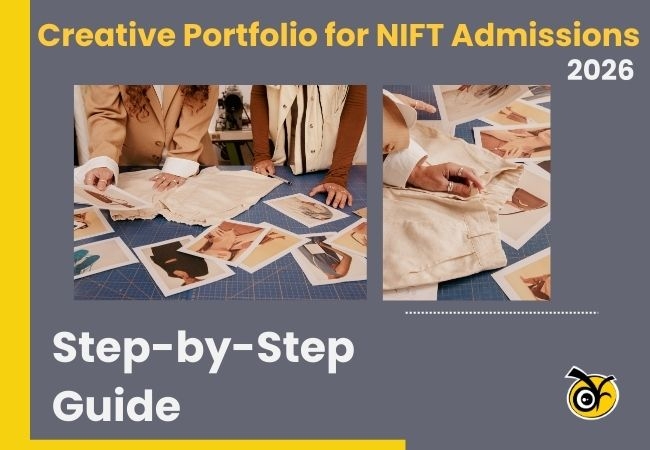
The National Institute of Fashion Technology (NIFT) is one of India’s most sought-after design schools. If you’re aiming for admission in 2026, your creative portfolio NIFT can be the single most powerful document that communicates your thinking, craft and potential to the admissions panel. This step-by-step guide breaks down the latest rules, timelines and practical portfolio-building steps so you can submit a confident, high-impact submission.
Quick note: NIFT’s official prospectus and admission guidelines are the final authority — always cross-check any deadline or submission rule on the official NIFT admissions pages before you submit.
Why the Portfolio matters for NIFT
Although NIFT’s selection is primarily driven by written tests (GAT and, for design courses, CAT) and subsequent practical rounds, a well-crafted NIFT portfolio preparation guide helps you in two important ways:
-
It demonstrates your visual language, problem-solving and craftsmanship beyond what a timed test can show.
-
It can be requested during further admission rounds or counselling processes (and is extremely useful for interview/situation test preparation).
Before you start: checklist & official rules
Read the official prospectus/admission guideline PDF and keep the following items ready before building your portfolio:
-
Valid photo ID (Aadhaar/passport) and scanned passport-size photo for application.
-
Application login credentials (you’ll fill the online application form on NIFT’s portal).
-
Digital copies of your best work in the file sizes and formats recommended by NIFT (check prospectus for file limits).
Important official pointers
-
NIFT applications are processed online; the portal will indicate what documents to upload during form-filling.
-
Keep printable versions of any work you may need to present during the Situation Test or later rounds — some rounds require physical or on-spot submission.
Step 1: Plan your portfolio strategy
Your portfolio is not a gallery — it’s a story. Follow these planning steps:
Goals to set
-
Define which course you’re applying for (B.Des, B.F.Tech, M.Des, etc.). Your portfolio should speak directly to the chosen course.
-
Identify 8–20 of your strongest works (quality over quantity).
-
Prepare 2–3 signature projects that show process — not just finished images.
What the admissions panel wants to see
-
Creative thinking and ideation.
-
Visual language: drawing, colour sense, composition.
-
Technical skill or craft relevant to fashion and design.
-
Process documentation: sketches, iterations, material studies, final resolution.
Step 2: Choose content types (what to include)
Mix of formats makes a portfolio memorable. Consider the following categories and include at least one example from each (where relevant):
-
Sketches & Concept Work — thumbnails, ideation and observational drawings.
-
Finished Design Work — garments, accessories, product mockups, illustrations.
-
Process Pages — moodboards, material trials, technical sketches, draping shots.
-
Photography / Flatlays — well-shot images of finished pieces.
-
Digital Design — CADs, flat sketches, pattern blocks, tech packs if applicable.
-
Personal Projects & Experiments — show curiosity and range.
-
Statement of Intent — a one-page explanation of your creative approach for the admissions panel.
Step 3: Document process (how to show work, not just tell)
The difference between average and excellent portfolios is process transparency.
For each project include:
-
Title & date
-
Problem statement — what were you trying to solve?
-
Research & references — moodboards, context and inspiration.
-
Iterations — early sketches, discarded directions, notes.
-
Final outcome — images and short explanations (1–3 lines).
-
What you learned — a line on skills or concept development.
Use clear captions and keep each project to a readable 1–2 page spread (digitally) — the admissions panel scans for clarity and intent.
Step 4: Presentation format & technical specs
NIFT’s application process is online, but rules about portfolio uploads or on-spot submission may vary year-to-year. Follow these guidelines:
-
Digital PDF portfolio: Standard for initial screening — keep file size under the portal limit (check prospectus for exact MB limit).
-
Image resolution: 150–300 DPI for print-quality images — compress so the total PDF stays within the size limit.
-
File naming & order: numbered project pages, concise file name; Example(“YourName_NIFT_Portfolio.pdf”).
-
Accessibility: Ensure fonts are legible and images are cropped consistently.
-
Backup: Keep a high-res and a low-res copy; have a few printed pages ready if an on-spot portfolio is requested.
Step 5: Polish — editing, critique & final checks
-
Get at least 2 external reviews — a teacher, a practicing designer or a coach.
-
Trim weak pieces; ruthless editing helps your strongest voice shine.
-
Proofread text; errors undermine professionalism.
-
Check chronology: present recent, relevant work early to make a strong first impression.
Step 6: Use your portfolio to prepare for exam rounds
NIFT selection typically involves GAT + CAT and for design programmes a Situation Test; the portfolio is your reference point for these rounds and interviews. Practice explaining your work clearly in 60–90 seconds per project — panels ask for concise storytelling during interviews and practical tests. The relative weightage of CAT, GAT and Situation Test is published in NIFT materials and guides — make sure you understand how the portfolio can support your situational problem solving.
Quick portfolio checklist (final pre-submission)
-
8–20 curated works with 2–3 process-heavy projects.
-
One-page statement of intent tailored to the chosen course.
-
PDF within portal size limits; named correctly.
-
Backups: high-res PDF and selected printed pages.
-
Practice 60–90 second project explanations for interviews.
-
Cross-checked deadlines and exact upload instructions on the official NIFT portal.
Final tips — what separates a great NIFT portfolio preparation guide from the rest
-
Tell a story: projects should flow and build on each other.
-
Show decisions: what you tried and why you changed course.
-
Keep authenticity: originality and honesty trump mimicry.
-
Be solution-oriented: design is about resolving constraints — illustrate that.
-
Stay updated: check NIFT’s official site and prospectus for any changes to upload rules or timelines before submission.
Building a compelling creative portfolio NIFT takes time and deliberate editing. Start early, document process at every stage, and keep the official NIFT prospectus and admission portal close at hand for any last-minute submission rules or format changes.
Leave A Reply
Latest Posts
Top 10 Best Fashion Design Colleges in Ahmedabad
Top 10 Graphic Design Colleges in India 2026 – Updated Guide with Fees, Admission Process & Placements
Top 10 Automobile Design Colleges in India (2026): Courses, Fees, Entrance Exams & Career Scope
Top 10 Architecture Colleges in India